



Polar Bears Still Under Water In The Thawing Arctic
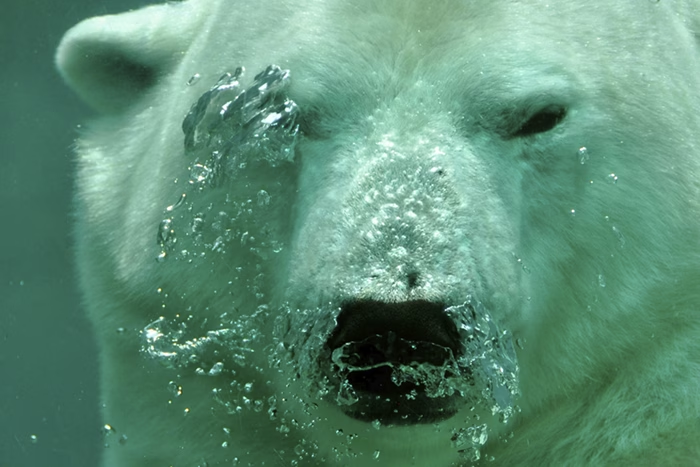
Dear EarthTalk: Are polar bears still in decline due to global warming?
– Patty Finch, Bowie, MD
Polar bears are a big part of the Arctic ecosystem. However, they are grappling with huge changes to their homes due to the effects of climate change. The bears are now listed as “vulnerable” by the International Union for the Conservation of Nature (IUCN). This puts them at a high risk of being endangered, which means they are at significant risk of extinction. The global polar bear population is estimated to be around 26,000. Some subpopulations are stable, while others are declining as a result of habitat fragmentation.
Greenhouse gas emissions have driven worldwide temperatures to an all-time high, causing Arctic Sea ice to melt. This is a crisis as polar bears rely on ice for all parts of their routine. Thus, polar bears are losing their habitats. Melting ice also affects the bears’ ability to hunt, since ice serves as a hunting platform. This affects not only adult bears and their survival, but also the cubs. According to Dr. Steven Amstrup, Chief Scientist Emeritus at Polar Bears International, “the longer the sea ice is gone from the productive zone, the tougher it is on the bears.”
Different polar bear populations have been affected in different ways. To wit, the populations in the Western Hudson Bay and Southern Beaufort Sea have faced the greatest decline. However, populations in the Barents Sea and Gulf of Boothia are likely to be stable at the moment. It’s important to note that many other regions are data deficient, causing a gap in statistics and information availability. In the late Dr. Ian Sterling’s book, Polar Bears: The Natural History of a Threatened Species, he asserts that “it is vital that all humans and their respective governments…help reduce greenhouse gas emissions…to ensure that both sea ice and polar bears persist for our children…”
Challenges in addressing these issues persist. International policy responses are slow, and industrial development continues to encroach on polar bears’ habitat and territory. Also, since the polar bear population is dispersed across 19 subregions, it’s hard to effectively coordinate actions between regions.
That being said, progress has still been made. The 1973 Agreement on the Conservation of Polar Bears brought together the five nations with the highest polar bear populations (Canada, Greenland, Norway, Russia and the U.S.), all who recognize that polar bears need effective protection. Furthermore, organizations like Polar Bears International and the World Wildlife Fund promote conservation, research, and advocacy. Individuals can support polar bear populations by supporting organizations, educating themselves, and being involved in advocacy. By saving these animals, we commit to taking action on climate change, both for humanity and the world.
CONTACTS
EarthTalk® is produced by Roddy Scheer & Doug Moss for the 501(c)3 nonprofit EarthTalk. See more at https://emagazine.com. To donate, visit https://earthtalk.org. Send questions to: question@earthtalk.org.