



Barred Owls In Federal Crosshairs For Threat To Spotted Owls
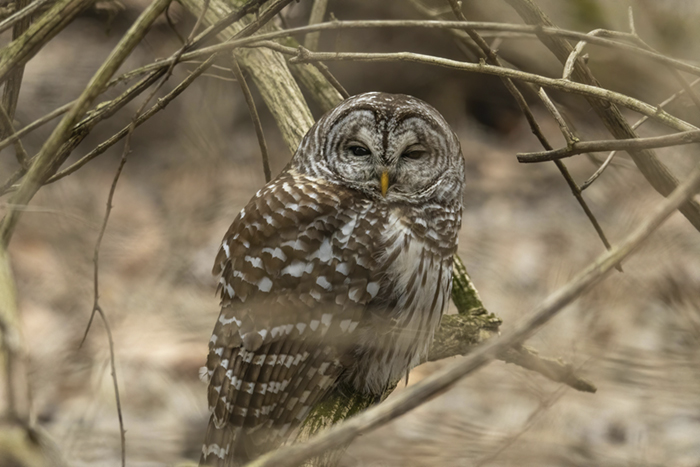
Dear EarthTalk: Is it true the federal government is planning to slaughter 450,000 wild owls in the Pacific Northwest? How do environmentalists feel about it?
—Paula T., Bend, OR
In 2025, the federal government released a controversial plan to remove 450,000 barred owls from Pacific Northwest forests in an attempt to protect the endangered spotted owl population. According to the U.S. Fish and Wildlife Service (USFWS), the number of spotted owls dropped by 75 percent over the past two decades and were officially classified as endangered in December of 2020. Environmental advocates are split over the issue: Is removing one owl species to protect another truly an ethical decision, or is it a necessary step towards creating safe habitats for endangered species?
Many officials agree that barred owl removal is an unfortunate but essential way to maintain the diminishing spotted owl population. Over time, barred owls have invaded the west coast, the spotted owls’ natural habitat. Barred owls are east coast natives and much larger than spotted owls, giving them an advantage in the western ecosystem. The plan would remove less than one percent of the barred owls, which some experts believe is a minimal cost to protect the mere 15,000 spotted owls left in the U.S.
“Without actively managing barred owls, northern spotted owls will likely go extinct in all or the majority of their range, despite decades of collaborative conservation efforts,” says Kessina Lee, the U.S. Fish and Wildlife Service Oregon state supervisor. “This isn’t at all about one owl versus another,” agrees Bridget Moran, another U.S. Fish and Wildlife Service official. “This is about having spotted owls. If we do nothing, we will have only barred owls. If we do something, we’ll have both.”
Many advocates have taken the opposing side, arguing that such a plan will lead to more destruction. Animal Wellness Action, a wildlife protection lobbyist group, filed a lawsuit against the strategy. They alleged that the USFWS did not thoroughly consider the impact and neglected alternative options, thus violating the National Environmental Policy Act. “The vastness of physical geography of the ‘control area’ makes the plan unworkable and impractical,” says Wayne Pacelle, president of Animal Wellness Action. In March 2025, 19 lawmakers wrote a bipartisan letter asking the federal government to abandon the strategy. The letter argued that barred owls were not invasive, but instead an important part of the ecosystem. That said, the U.S. Senate voted 25-72 against the effort to stop the plan in October 2025.
Readers interested in getting involved can call your congressional representatives to take action.
CONTACTS
- To save spotted owls, officials plan to kill a half-million of another owl species
- Senate declines to halt plan to kill off half-million barred owls by Fish and Wildlife Service
EarthTalk® is produced by Roddy Scheer & Doug Moss for the 501(c)3 nonprofit EarthTalk. See more at https://emagazine.com. To donate, visit https://earthtalk.org. Send questions to: question@earthtalk.org.