



Soilless Farming: Better For The Planet?
Dear EarthTalk: What is “soilless” farming and is it better for the planet?
—B.R., via email
Farming is far from friendly to the environment. According to Our World in Data, 26 percent of greenhouse gas emissions come from food production and 50 percent of the world’s habitable land is used for agriculture. The Green Revolution solved the food shortage problem, but now, we humans need a new revolution to preserve and conserve natural resources– a “soil-less” revolution.
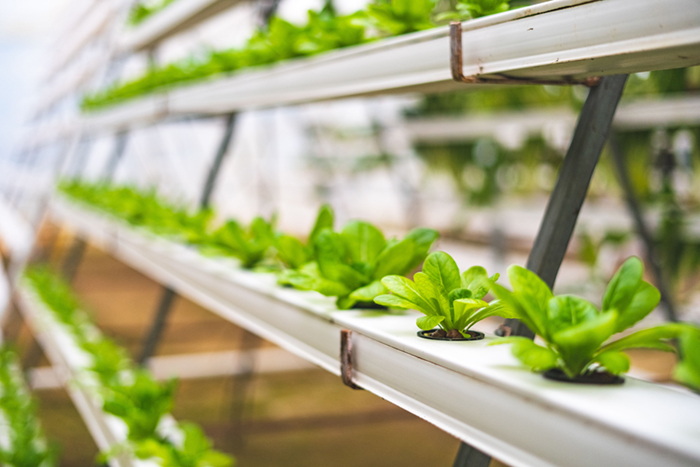
Three main types of soil-less farming are in practice today: hydroponics, aeroponics and aquaponics. Hydroponics, like its name suggests, cultivates crops in a nutrient-rich water supported by an inert medium such as perlite, coconut coir or rock wool. In aeroponics, plants are suspended in air and their roots are misted with a nutrient solution. Aquaponics has its roots in ancient China and Babylon. Essentially, it combines hydroponics and aquaculture in a symbiotic relationship. Fish and crops are raised together: fish waste fertilizes plants and plants purify water for fish.
A shift to soil-less farming can revert our current environment into a healthier, more balanced one. According to the World Wildlife Fund, “greenhouse hydroponics uses only 10 percent of the water needed for traditional farming.” Additionally, soil-less cultivation yields more crops and produces fresh fruits and vegetables on a year-round basis, thanks to the controlled growing environment. With reduced exposure to pests and diseases, crops require little to no herbicide, lowering the amount of toxic water run-off. Finally, soil-less farming is more compact. Acres of land once used for cultivation can be returned back to nature, increasing biodiversity.
However, challenges persist in making the switch. For one, the initial cost is tremendous. Soil-less farming relies more heavily on technology; in consequence, equipment and set-up costs run in the tens of thousands ($50k for 500 sq. ft.). Hydroponics, aeroponics and aquaponics also need more attention and technical expertise. Farmers must learn to manage new high-tech equipment and keep a watchful eye on the delicate nutrition balance. Besides the cost and human capital needed, soil-less farming is a high energy investment, which may offset any environmental gains. One study by World Wildlife Fund shows that the carbon footprint of lettuce grown on a traditional farm in California is less than that of a soil-less agricultural system. With more efficient technology, though, energy input can be reduced. Soil-less cultivation is the future for cleaner and more sustainable agriculture. Curious how plants can grow without soil? Try it yourself! Search up “at home hydroponic systems” and plenty of online resources can help you get started to an eco-friendly future.
CONTACT
EarthTalk® is produced by Roddy Scheer & Doug Moss for the 501(c)3 nonprofit EarthTalk. See more at https://emagazine.com. To donate, visit https://earthtalk.org. Send questions to: question@earthtalk.org.