



Indigenous Tribes Upset At Cargill’s Continuing Exploitation of Brazil’s Amazon
Dear EarthTalk: Why are indigenous tribes so concerned about what Cargill is doing in the Brazilian Amazon and what are they doing about it?
—H.H, via email
In fourteen hundred ninety-two Columbus sailed the ocean blue. A lighthearted beginning to the commonly taught story retelling the “discovery” of the Americas often neglects the realities of what it all meant for indigenous communities. Today native tribes of the Brazilian Amazon, some 900,000 people, continue to face threats to their land and rights. Despite gaining property rights under the Brazilian constitution in 1988, these protections are often diluted by government actions influenced by corporate actors. Former Brazilian President Jair Bolsonaro actively worked to loosen restrictions on indigenous lands to favor corporations, stating, “Where there is Indigenous land, there is wealth underneath it.”
Brazil is a global leader in agricultural exports, shipping a record 109 million tons of soybeans in 2025. At the center of this industry is Cargill, a multinational company with $160 billion in earnings that exports 70 percent of Brazil’s soy and maize. The government reaps significant economic benefits from this business and has cleared the way for its expansion by pursuing what locals call the “grain train,” a railway that would cut across the Amazon to further build capacity for soy exports.
Tensions reached a breaking point following current President Lula da Silva’s December 2025 decree to privatize the Tapajós, Madeira and Tocantins rivers, a plan to boost agricultural exports, with Cargill positioned as a primary beneficiary. Pedro Charbel of Amazon Watch noted these actions “would increase, sevenfold, the amount of soy they export through the Tapajós.” The government argues that increasing export traffic through the rivers is more environmentally friendly than land-based transportation. However, experts from GT Infraestrutura, a Brazilian coalition of civil society organizations, warn this infrastructure will accelerate deforestation. The Human Rights Research Center (HRRC) further identifies that resulting water pollution and habitat loss will drive indigenous communities further into the Amazon due to food insecurity.
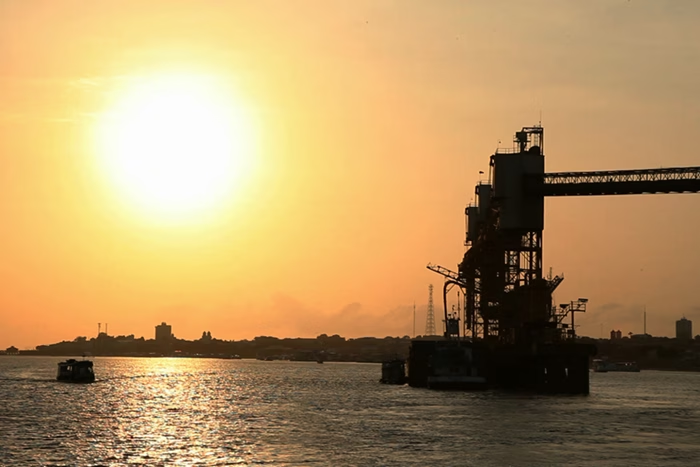
Indigenous tribes challenged the decree in court, arguing it violated laws requiring prior consultation with tribal groups. When that failed, they occupied Cargill’s terminal in Santarém, intercepting a grain ship with banners reading, “The Tapajós River isn’t for sale” and “Revoke the Decree of Death.” After 33 days, da Silva revoked the decree, protecting at least 17 indigenous territories. This victory preserves vital forests that provide a global service: storing more carbon than non-native lands. Staving off corporate expansion is essential for maintaining these carbon sequestration benefits. Consumers can support these efforts by demanding the industry return to the Soy Moratorium, a 2006 pact to avoid buying soy from deforested land, which Greenpeace calls “the world’s single most successful zero-deforestation plan”.
CONTACTS
EarthTalk® is produced by Roddy Scheer & Doug Moss for the 501(c)3 nonprofit EarthTalk. See more at https://emagazine.com. To donate, visit https://earthtalk.org. Send questions to: question@earthtalk.org.