



Green Plastics
Environmentalists might not like credit cards, but at least they can get one that gives a portion of the money spent back to an environmental non-profit…

Environmentalists might not like credit cards, but at least they can get one that gives a portion of the money spent back to an environmental non-profit…
Its use predates Christopher Columbus, but this easy-to-grow plant fiber is capable of replacing wood as the raw material in paper, grows without the use of pesticides or herbicides and is one of the most versatile alternative resources of our time. And, in certain forms, it’s also highly illegal. It’s time to get reacquainted with hemp.
These days, people are spending more time outdoors for sun, sport and recreation–at precisely a time when depletion of the Earth’s ozone layer (caused by the release of chlorofluorocarbons [CFCs] from aerosols, refrigerators and air-conditioners) is putting us at greater and greater risk of sun damage.
Lighting accounts for 20 to 25 percent of all electricity sold in the U.S., according to the Environmental Protection Agency (EPA). With Americans paying eight cents per kilowatt hour, energy-efficient lighting is starting to look very appealing to consumers. And because energy costs can also add up quickly from frequently-used appliances, small changes can equal big-time savings.
Every summer through most of the 1980s, an awful smell wafted its way across the west side of Bridgeport, Connecticut–a stench ultimately traced to the premises of Herman Isaacs, Inc. Once you knew how the long-established company did business, it wasn’t surprising to learn that its operations stunk to high heaven. Isaacs, now closed, was a meat rendering plant; it bought spoiled meat scraps, animal carcasses, and other "offal" and transformed this waste product into an inoffensive, high-protein base for such products as designer soaps, medicines, candy (yes, candy) and a whole lot of other things you’d never suspect had meat in them.
Oddly enough, one reason cows are eating more of each other these days has to do with recombinant bovine growth hormone (rBGH), a synthetic form of the controversial hormone the dairy industry is employing to stimulate milk production. Marketed under the name "Posilac," Monsanto’s rBGH is the first genetically engineered food product to win FDA approval. Injected into a cow’s pituitary gland every two weeks, rBGH (also known as BST, or bovine somatotropin) can increase milk output by up to 25 percent.
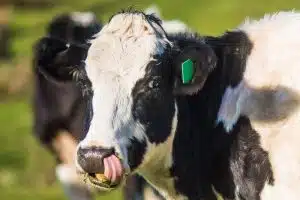
In 1985, a previously healthy Holstein dairy cow in England became edgy and uncoordinated. It had difficulty standing and walking, and became aggressive and unpredictable. Death came quickly, and an examination revealed a startling fact: Its brain was riddled with holes, like a sponge. The cow’s condition was later given a name: Bovine Spongiform Encephalopathy, or BSE. "Mad cow disease" had arrived.
Through 1989, when the annual global fish catch peaked at 86.1 million metric tons–a nearly fivefold increase over the recorded haul in 1950–the notion of unlimited bounty prevailed. Since then, we’ve witnessed a precipitous decline, especially in the Atlantic, Pacific and Mediterranean. Canada’s Grand Banks and New England’s Georges Banks–once among the most plentiful fishing grounds anywhere–have undergone complete collapse. With the virtual disappearance of haddock, cod and yellowtail flounder, an emergency federal closure of more than 6,000 square miles off the Massachusetts coast was ordered late in 1994, shutting down a $200-million-a-year industry.
Twillingate, Newfoundland—-Kill seals, save cod. That’s the rule followed by the Canadian government, which this year authorized the killing of a quarter-million harp seals, whose burgeoning population could be having an effect on depleted stocks of Atlantic cod, their favorite food. By early May, the hunters were mopping up, shooting the seals bobbing along Newfoundland’s northern shore.
It’s hard to believe, but the United Nations estimates that about 27 million tons of fish each year–a third the volume of the regular commercial catch–are caught and then tossed back (usually dead) because they are the wrong species, too small, damaged in capture or exceed a particular quota. And some estimates peg the real amount at closer to 40 million tons. In the industry, it’s known as unwanted "bycatch."