
Solar Powered Trains Show Promise For Short Hops
Dear EarthTalk: Is anybody working on solar-powered trains, and if so, when will they be ready for prime time?
—Paul Best, Los Angeles, CA
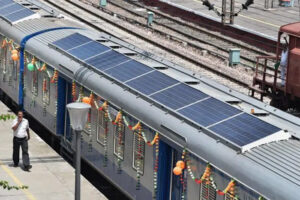
Solar-powered trains run on the Sun’s energy to operate, via solar panels placed on train stations, on the roofs of trains, or most commonly, from the rail tracks. They also often gain indirect energy from the sun, using electricity from solar farms that is sometimes stored in batteries to facilitate auxiliary functions other than propulsion, including lighting, ventilation and GPS systems. Most solar train travel as of 2026 has been for short distances, optimal for tourism and urban shuttles, like the Byron Bay Train in Australia.
However, there are significant plans to achieve long-term solar train travel across the world. Unlike traditional diesel-powered trains, solar-powered trains are highly sustainable and offer an improved climate future because they rely on clean and renewable energy. Like other renewable energy sources, solar power improves the environment because it decreases environmental tensions and pollutants that arise with the use of fossil fuels.
In 2019, the International Earth Agency predicted that the global rail network could expand to almost 2.1 million kilometers by 2050. In 2024, Argentina unveiled its first solar-powered tourist train with a range of about 41 kilometers. Since introducing their first solar-powered train in 2017, India has also joined the effort. Indian Railways plans to develop 20 gigawatts of solar energy in vacant lands by 2030. The U.K. and Switzerland have also made efforts to introduce solar energy in train travel.
In 2017, Alice Bell, co-director at the U.K. climate change group Possible, wrote in The Guardian, “We think solar could power 20 percent of the Merseyrail network in Liverpool, as well as 15 percent of commuter routes in Kent, Sussex and Wessex…trains and trams all over the world could be running on sun in a few years’ time.” Approved in 2008, California’s solar-powered high-speed train will run approximately 1287.5 kilometers and is the first of its kind across the world. This train is set to be completed in 2030 and hopes to connect to cities like Vancouver, San Diego and Los Angeles.
While solar-powered train projects are promising, they still face financial, operational and timing challenges. Many have to do with train maintenance and durability, which can impact the safety of train operations. Nevertheless, solar trains could completely shift the current state of climate-conscious transportation.
CONTACTS
EarthTalk® is produced by Roddy Scheer & Doug Moss for the 501(c)3 nonprofit EarthTalk. See more at https://emagazine.com. To donate, visit https://earthtalk.org. Send questions to: question@earthtalk.org.